
Project offers housing to give independence to young people with disabilities
JNG Institute has moved into the Novo Mundo Hotel.
In the Flamengo neighborhood, in Rio's South Zone, the former Novo Mundo Hotel was transformed into a student residence in 2019. Since November of last year, the building has housed another new addition: the JNG Institute, a pioneering independent housing project for adults with intellectual disabilities and autism, has moved into the 11th floor. The NGO leading the project brings together health professionals, educators, and therapists, as well as architects and urban planners.
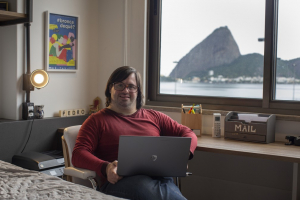
From his bedroom window, 31-year-old Pedro de Sá Baião has a breathtaking view: the landscape, a parade of postcards, includes Guanabara Bay, Sugarloaf Mountain, and Christ the Redeemer. Six months ago, the young man, who has Down syndrome, left the comfort and security of his parents' home in Leblon to fulfill his dream of living alone.
I wanted to live this new experience, to create independence, in a place where I could have my own space and develop my hobbies. It's been a wonderful experience," says Pedro, who, in addition to taking care of his property, goes alone to the Estácio de Sá University campus in Barra da Tijuca, where he is in his third year of studying Audiovisual Production, and now only returns to his parents' house as a visitor.
Own routine
Hotel Novo Mundo is managed by Uliving, a company that operates properties in other Brazilian cities, including São Paulo, Ribeirão Preto, and Campinas. The chain offers a shared housing concept for people seeking a sense of community, savings, and a sustainable lifestyle.
At its Rio address, the JNG Institute project opened with capacity for ten to twelve residents, but is seeking other partners to expand. For now, the initiative only operates in Rio de Janeiro, but the potential target audience is large. According to data from the last census in 2010, there are 17 million people in Brazil with some type of disability—of this group, 2.6 million have some type of mental or intellectual disability.
Pedro is one of the six current residents on the 11th floor, with a seventh on the way. They are between 23 and 32 years old, and most of them previously lived in Rio.
Each of the project's pioneering participants occupies a small apartment with a bathroom, bedroom, and kitchen. In this space, they can exercise their individuality and develop their own routine. Collaborative living is encouraged in the various common areas, such as a game room, work and study area, a small cinema, and a communal kitchen.
We seek to broaden the horizons of these young people who are about to become adults. The project's goal is to promote autonomy and independent living, through the prospect of leaving their parents' home, and also to connect them with companies where they can work. Here, we build human bridges," explains Flávia Poppe, director and founder of the JNG Institute.
For residents participating in the project, support goes beyond traditional room service: a team is on call 24 hours a day, 7 days a week. These professionals' role is to assist young people with whatever they need, whether it's medication guidance or even assistance with a job screening—a mission accomplished yesterday by 41-year-old educational psychologist Aline Bastos. This team, composed of six people, occupies the same floor and is supported by a panel of specialists comprised of a psychologist, a social worker, and an educator.
Our job here is to develop skills to create autonomy for each person — says Aline.
The project was named after the initials of three young people who inspired it: João, Nicolas, and Gabriela. Founder Flávia Poppe is the mother of 30-year-old Nicolas, diagnosed with autism spectrum disorder, and the only one of the three who agreed to live in the residential home.
Flávia says the idea stemmed from her anguish as a mother: after finishing school, many of these young people and their parents don't envision a new horizon for themselves in adulthood. In her research, she found no references in the country, but she became interested in a project in England. Admission to the JNG Institute isn't cheap. Paid for by families, the monthly cost for each resident ranges from R$7,500 to R$8,000, including rent, condominium fees, internet, cable TV, and 24-hour personalized service from trained professionals. Meals and medical services are charged separately.
Just like Pedro de Sá Baião, who is also an actor and dreams of working in film and TV, Manuela Araújo, 27, said that the decision to leave her mother's house, with whom she lived in Largo do Machado, was the realization of a long-held dream.
"I wanted to live alone, to have my independence, my individuality, and my freedom. I'm enjoying it. It's a daily learning experience," says the young woman, who indulges her hobby in the shared kitchen, where she shares spoonfuls of brigadeiro, her specialty.
'Why not?'
Luciano Elia, professor of Psychoanalysis at the Institute of Psychology at UERJ, sees good prospects in the project, but notes that singularities must be respected:
If at least these individuals and their desires are considered in advance, why not? As long as it's not too technical, which ends up placing people in a segregated position in society, I think it could be a solution. It could be interesting, if singularities are respected and pre-emptive models of autonomy are not used to generate demand, which would be just another profit-driven project.
source: https://oglobo.globo.com/rio/noticia/2022/06/projeto-oferece-moradia-para-dar-independencia-a-jovens-com-deficiencia.ghtml



Leave a Reply
Want to join the discussion?Feel free to contribute!